
Some men would like to have a vasectomy even though their primary sexual partners (wives, fiancées, or long-term girlfriends) have already undergone bilateral tubal ligation, otherwise known as "BTL", "tubal", "tubal ligation", "tubes tied", or "female sterilization". There are a number of reasons for this:
The first reason is adequate justification for vasectomy, with the intended goal (avoidance of pregnancy with outside partners) being worth the risks of vasectomy.
The second reason is not MEDICALLY justifiable. That is, the risk of pregnancy after either vasectomy or tubal ligation is so low that the risk of either procedure is probably greater than the risk of pregnancy after either procedure. In the couple's minds, the two procedures may be SOCIALLY justifiable, but the second procedure does pose an unwarranted medical risk. My suggestion to such couples is that if they want to demonstrate their commitments to each other, an alternative method, such as simultaneous tattoos, would be less risky.
The third reason may be medically justifiable. One must compare the risks of vasectomy with the risk of pregnancy after tubal ligation. Data varies about both risks. See the table below.
CERTAINLY a tubal after a vasectomy is not justifiable, unless a woman has extramarital partners. A vasectomy (A) is less risky than a tubal [tubals are performed under general anesthesia and involve entry into the abdomenal cavity], (B) has an extremely low failure rate, and (C) can be easily monitored periodically by simply having a qualified person in a lab look at a semen specimen under a microscope for the presence or absence of sperm. The exception to "A" is the tubal performed as part of a scheduled Caesarean section. If a man with a pregnant partner due to have a C-section (because of large twins or prior C-section) is considering vasectomy, he should delay vasectomy until after the birth. If his partner does have a C-section and undergoes tubal ligation during that C-section, he should NOT have a vasectomy, because the risk of vasectomy outweighs the risk of pregnancy after the BTL.
Is vasectomy after a tubal warranted to decrease the risk of unwanted pregnancy? That depends on the technique used for the tubal and the track record of the vasectomy provider. The risk of vasectomy (post-procedure bleeding, infection, or chronic pain), albeit low, may be comparable to the risk of pregnancy after BTL, depending on the technique used for the BTL. It is true that depending on the techniques used, tubals fail more frequently than vasectomies. It is true that tubals cannot be monitored for effectiveness as easily as vasectomies. To monitor a vasectomy, one need only submit a semen specimen for microscopic analysis for the presence or absence of sperm, a test which is inexpensive and carries NO RISK. But to monitor a BTL (to determine whether the tubes have "grown back together"), a woman would have to undergo an X-ray test called a hysterosalpingogram (HSG), during which contrast is injected into the uterus to see whether it passes into and through the tubes. An HSG is expensive and carries the risks of radiation exposure and infection, so it is almost never performed to monitor tubal effectiveness. It is true that when pregnancy occurs after vasectomy, it is usually a healthy uterine pregnancy. In contrast, when pregnancy occurs after BTL, half are ectopic (outside the uterus and usually within one of the tubes) and represent a surgical emergency because they can rupture and the woman can die (though death is very rare in communities where good health care is readily available). So for a number of reasons, vasectomy is preferable to tubal ligation as a form of sterilization. But if your partner has already had a tubal ligation, the risk of vasectomy may be greater than the risk of pregnancy after tubal ligation. If the fear of pregnancy after tubal ligation (the fear of tubal failure) is so unsettling that you do not enjoy sex, vasectomy is justifiable to relieve that fear.
For those who want more detail: keep in mind that tubal ligation can be performed at three different "times" using one of a number of "techniques". Those "times" are:
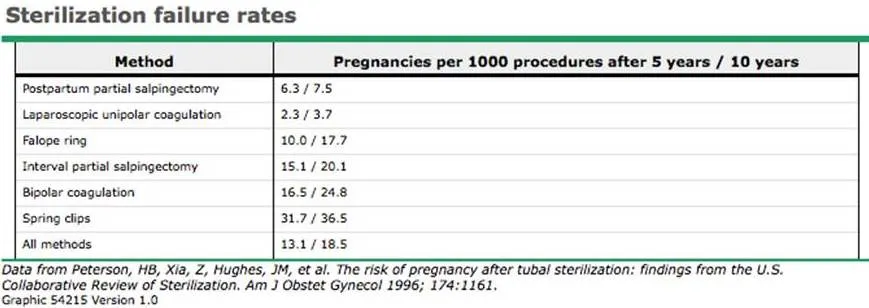
What this means is that, in the case of "Postpartum [after delivery] partial salpingectomy [removal of part of the tube]" (first line), 6.3 out of 1000 women, or 63 out of 10,000 women, will become pregnant within the first 5 years after this method of tubal blockage. That is fewer than 1%. In contrast, over 3% of women whose tubes are blocked with "spring clips" will become pregnant within the first 5 years after this method. Why would anyone use spring clips? Well, in the hands of some surgeons, spring clips may have a lower complication rate than other methods. The point is that tubal ligation failure rates may vary 10-fold with the technique used, but ALL methods of tubal ligation are very dependable compared with other forms of contraception. Birth control pills (BCPs), for example, have a failure rate of 3% EVERY YEAR. That is, of 100 women using BCPs, 3 will become pregnant every year. In contrast, of 100 women who have had tubals, 3 will become pregnant over 10 YEARS. So BTL is TEN TIMES more dependable than birth control pills. If a couple is concerned about a woman's risk of tubal ligation failure, and if the records of the tubal ligation method are available, and if a 0.37% failure risk vs. 3.65% failure risk over 10 years would influence their level of confidence in the BTL and their decision to opt for vasectomy, they could always review those records with her gynecologist to determine her personal risk of pregnancy.